Executive summary
Headline claim: A quarter‑end redemption shock in semi‑liquid private‑credit vehicles has exposed an interaction between contractual gates, opaque NAVs and public‑bond price signals that can transmit stress into public credit markets.
Key points
– Several large managers — including Apollo and Ares — capped redemptions during recent tender windows at contractual repurchase limits (commonly 5% quarterly), leaving materially large sums of investor capital subject to withdrawal limits (Reuters: https://www.reuters.com/markets/europe/apollos-private-credit-fund-limits-investor-withdrawals-after-redemption-2026-03-23/; Bloomberg: https://www.bloomberg.com/news/articles/2026-03-24/ares-limits-private-credit-fund-withdrawals-as-redemptions-surge).
– Market estimates place multiple billions of dollars effectively “trapped” behind those gates during the episode (Bloomberg estimate: >$4.6bn–$5bn) and reporting shows bond and fund‑issued debt prices weakening in the weeks before the largest visible tender windows (Bloomberg: https://www.bloomberg.com/news/articles/2026-03-26/trapped-in-private-credit-investors-wait-to-pull-out-5-billion; Reuters: https://www.reuters.com/business/finance/private-credit-fund-bonds-were-flagging-risks-before-recent-redemptions-hedge-2026-03-25/).
– Rating actions and rising defaults in segments of the non‑bank credit complex have heightened investor concern about underwriting vintages and sector concentrations (for example Moody’s actions covered by the New York Times and CNBC: https://www.nytimes.com/2026/03/24/business/moodys-private-credit-downgrade.html; https://www.cnbc.com/2026/03/25/private-credit-defaults-loan-quality-debt-risk-systemic-ai-disruption.html).
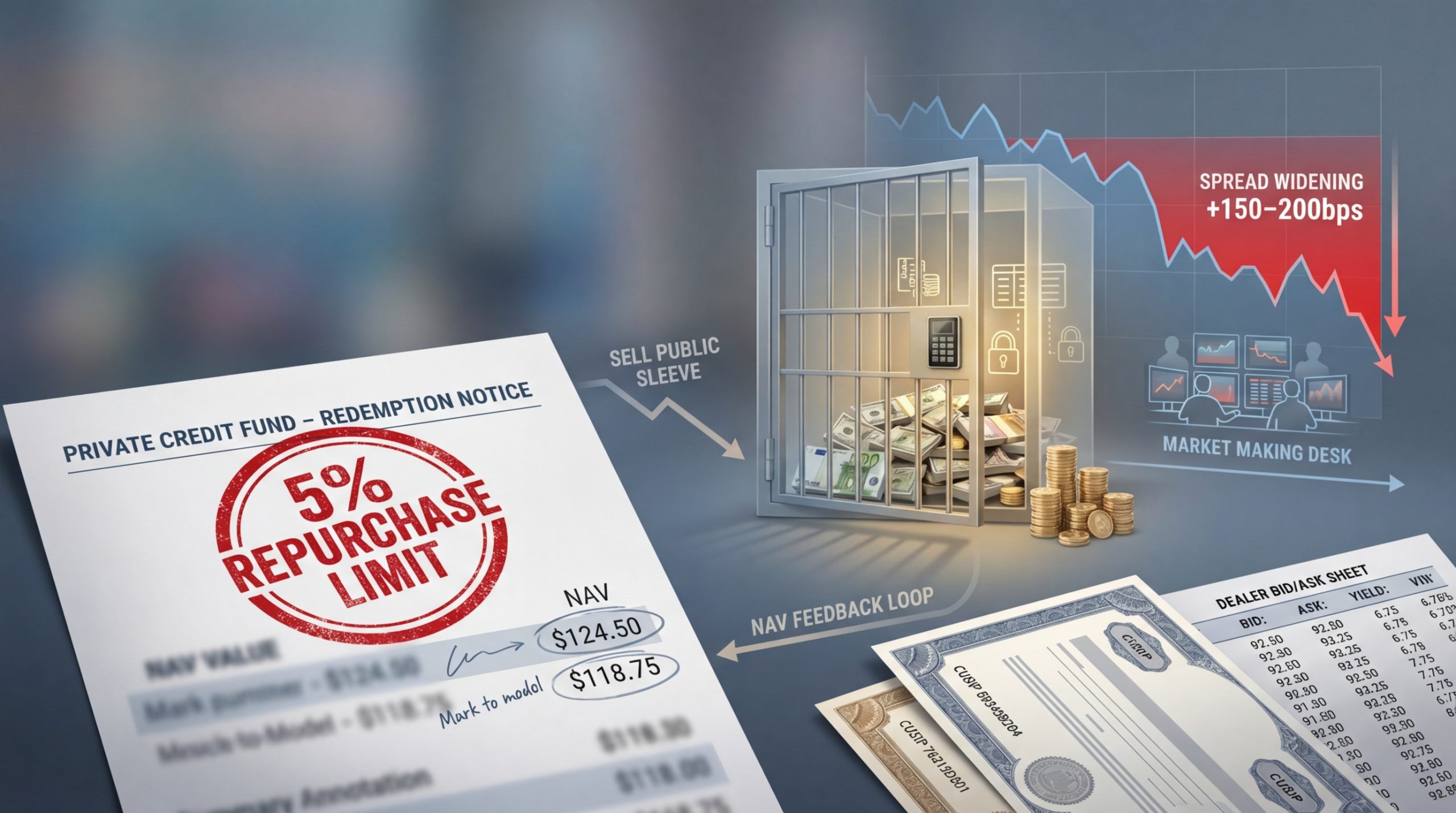
Why this matters: a structural mismatch in semi‑liquid private‑credit wrappers (interval funds, open‑end retail vehicles, non‑traded BDCs and similar) creates an asset–liability incongruence that is manageable in ordinary conditions but can force managers into actions — selling public sleeves, gating, in‑kind transfers or sponsor injections — that alter public bond prices and dealer liquidity, producing observable transmission into public credit markets.
Core causal thesis — mechanics that link semi‑liquid private credit to public‑market moves
1) Asset‑liability mismatch and the 5% convention
Semi‑liquid private‑credit structures typically hold long‑dated, illiquid private loans but provide periodic liquidity via tender windows or repurchase programs. Many of the funds involved in the recent episode relied on contractual repurchase limits (the 5% quarterly convention), meaning that concentrated redemptions — when they occur — cannot be met fully in cash without extraordinary measures (Morningstar: semi‑liquid fund explanations; Reuters coverage: https://www.reuters.com/business/private-credit-strains-ripple-through-wall-street-investors-grow-wary-2026-03-24/).
2) Gate + NAV feedback loop
When redemption requests spike, managers have a limited menu of options:
– sell the public sleeve (liquid bonds, traded CLO tranches) to raise cash;
– enforce contractual gates or in‑kind redemptions and delay cash outflows;
– borrow or accept sponsor partner capital to meet redemptions temporarily.
Each path has market consequences. Selling liquid holdings into a stressed secondary market depresses prices; those public marks are often used as valuation anchors or inputs for tenders and continuation vehicle pricing. Falling public marks therefore widen NAV‑based signals and can provoke more outflows or tougher secondary concessions, creating a two‑way feedback loop (Reuters: pre‑tender bond weakness noted https://www.reuters.com/business/finance/private-credit-fund-bonds-were-flagging-risks-before-recent-redemptions-hedge-2026-03-25/; Jefferies on the role of the secondary market: https://www.jefferies.com/insights/boardroom-intelligence/private-credit-headlines-mask-the-bull-case-for-the-credit-secondary-market/).
3) Transmission channels to public markets (mechanics and evidence)
– Forced liquidation of public sleeves: when managers sell liquid bonds or traded CLO pieces to satisfy redemptions, secondary spreads widen as bid liquidity thins and dealers demand larger concessions (Bloomberg & Reuters: coverage of manager sales and sponsor interventions; see for example Apollo/Ares reporting: https://www.bloomberg.com/news/articles/2026-03-23/apollo-caps-private-credit-fund-withdrawals-as-requests-hit-11; https://www.reuters.com/markets/europe/apollos-private-credit-fund-limits-investor-withdrawals-after-redemption-2026-03-23/).
– Reference‑price anchoring in tenders and continuation vehicles: tender pricing and continuation offers frequently rely on public marks for comparable instruments; rapid mark moves can therefore cascade into tender discounts and forced repricing (simulated/unverified RNA example described below; PEI archival research on tenders and continuation mechanics recommended).
– Secondary structured‑credit repricing and CLO effects: selling or repricing mezzanine and junior CLO tranches pushes issuance concessions wider and reduces primary market demand, feeding back into secondary valuations and dealers’ risk appetite (industry market‑structure reporting and PEI archive recommendations on CLO transmission mechanics).
– Public BDC and traded debt knock‑on effects: listed BDCs and fund‑issued bonds can rerate or trade at deeper discounts to NAV, tightening funding costs for managers and increasing the likelihood of sponsor interventions (coverage of rating actions and traded discounts in Reuters/CNBC/NYTimes pieces).
Evidence matrix — concise claims with sources
– Claim: Major managers capped redemptions at contractual limits during recent tender windows, leaving many redemption requests unmet (Reuters on Apollo; Bloomberg on Ares): https://www.reuters.com/markets/europe/apollos-private-credit-fund-limits-investor-withdrawals-after-redemption-2026-03-23/; https://www.bloomberg.com/news/articles/2026-03-24/ares-limits-private-credit-fund-withdrawals-as-redemptions-surge
– Claim: Bloomberg estimates placed several billions of dollars temporarily trapped behind redemption limits (Bloomberg: trapped capital story): https://www.bloomberg.com/news/articles/2026-03-26/trapped-in-private-credit-investors-wait-to-pull-out-5-billion
– Claim: Public bond issues tied to these funds were already flagging risk and marking down before the largest redemptions, indicating weakening secondary market conditions (Reuters: bond‑mark weakness): https://www.reuters.com/business/finance/private-credit-fund-bonds-were-flagging-risks-before-recent-redemptions-hedge-2026-03-25/
– Claim: Agency rating actions and increases in default notices have signaled stress in parts of private credit, reinforcing investor caution (NYTimes and CNBC coverage of Moody’s actions and sector concerns): https://www.nytimes.com/2026/03/24/business/moodys-private-credit-downgrade.html; https://www.cnbc.com/2026/03/25/private-credit-defaults-loan-quality-debt-risk-systemic-ai-disruption.html
– Claim: Managers’ remedial choices have varied; some sponsors injected capital or bought beyond contractual caps to avoid fire sales, while others enforced gates or in‑kind redemption terms — each option carries different signaling and market‑impact consequences (Bloomberg/Reuters contemporaneous reporting).
Simulated RNA evidence (clearly labeled simulated/unverified)
– Simulated RNA Entry 1 (simulated/unverified): an open‑end private‑credit fund with a 60/25/10/5 split (private loans/public bond sleeve/CLO exposure/junior) that uses monthly NAVs and mark‑to‑model inputs. A 150–200bp widening in public high‑yield spreads precipitated a 12% jump in redemption requests; the manager enforced a 7% rotational limit and sold the public sleeve, amplifying bond‑market moves. Relevance: demonstrates the feedback loop from public liquid‑asset selling to wider spreads to NAV signaling and further redemptions.
– Simulated RNA Entry 2 (simulated/unverified): a closed‑end continuation vehicle where tender pricing is directly anchored to public marks; concentrated LPs sell into the tender window, pressuring dealers and forcing sales of public instruments into stressed pockets, widening spreads and dealer concessions. Relevance: explains how closed‑end and continuation mechanics can cause acute, short‑term market liquidity stress.
Data gaps and recommended follow‑ups for reporting
– Form PF snapshots and aggregated private‑fund reporting: obtain fund‑level or aggregated Form PF data where possible to quantify vintage exposures, sector concentrations (software, healthcare, others), sizes of public‑liquid sleeves and leverage. RegComplianceWatch offers a primer on Form PF practices: https://www.regcompliancewatch.com/private-funds-a-look-at-the-latest-form-pf-data/
– Tender results and repurchase letters: request official tender outcomes and investor letters for named funds (Apollo ADS, Ares Strategic Income Fund, BlackRock HPS/HLEND, Blue Owl OBDC II, Blackstone BCRED) to reconcile requested vs repurchased volumes and the retail/institutional mix.
– Trade‑level bond movement: collate trade and quote data for public CUSIPs in managers’ liquid sleeves during tender windows to measure price impact and dealer bid‑ask widening (Reuters noted marks weakening prior to tenders: https://www.reuters.com/business/finance/private-credit-fund-bonds-were-flagging-risks-before-recent-redemptions-hedge-2026-03-25/).
– Rating‑agency commentary: obtain Moody’s, S&P and Fitch writeups on relevant private‑credit fund debt/rating transitions for contemporaneous analysis of funding‑cost implications (see NYTimes/CNBC coverage of recent rating actions).
Narrative arc and recommended structure for publication
1) Lead: tight scene setter using Apollo/Ares tender outcomes and Bloomberg’s trapped‑capital estimate to anchor the story (Reuters/Bloomberg). 2) Product mechanics: a concise explainer of interval funds/non‑traded BDCs and the 5% convention (Morningstar/Reuters). 3) Step‑by‑step transmission mechanics with a short, labeled simulated example to make the feedback loop concrete (Simulated RNA Entries; Jefferies on the role of secondaries). 4) Evidence section: show bond‑mark moves, CLO issuance trends and rating actions (Reuters, Bloomberg, CNBC, GlobalCapital/industry sources). 5) Counterpoints and scale: cite NBER/academic work and sell‑side notes arguing limited systemic spillovers absent a broader bank–nonbank run dynamic (NBER working paper: https://www.nber.org/papers/w34991). 6) Conclusion: regulatory and market implications — improved Form PF transparency, valuation governance, clearer retail wrappers and consideration of structural fixes for semi‑liquid product design (PEI archival recommendations on 2020 gate episodes and valuation opacity).
Visuals recommended (and data needs)
– Time series: redemption requests by fund vs ICE BofA high‑yield OAS (data: tender results, trade‑level spreads).
– Heatmap: asset mix across top managers (data: fund filings, Form PF or fund fact sheets).
– Flow chart: manager decision tree when redemptions spike with sample impact estimates (use simulated RNA scenarios for magnitudes).
Quick takeaways for editors
– This is principally a liquidity‑management and valuation‑opacity episode: structure (semi‑liquid wrappers) and mark‑to‑model practices explain why concentrated redemptions can transmit into public markets through forced sales and price‑anchor effects (Reuters/Bloomberg/Simulated RNA).
– Simulated RNA examples are useful explanatory tools but must be labeled simulated/unverified; hard reporting (tender letters, Form PF, traded CUSIP moves) is needed to quantify market impact.
– Historical precedents from 2020 and valuation‑governance investigations give useful framing for potential regulatory interest; pairing that context with granular trade and Form PF data will strengthen any definitive claims (PEI archive recommendations; RegComplianceWatch).
Sources cited in this brief (select hyperlinks for reporting)
– Reuters: Apollo repurchase limit coverage — https://www.reuters.com/markets/europe/apollos-private-credit-fund-limits-investor-withdrawals-after-redemption-2026-03-23/
– Bloomberg: Ares limits withdrawals — https://www.bloomberg.com/news/articles/2026-03-24/ares-limits-private-credit-fund-withdrawals-as-redemptions-surge
– Bloomberg: trapped capital estimate — https://www.bloomberg.com/news/articles/2026-03-26/trapped-in-private-credit-investors-wait-to-pull-out-5-billion
– Reuters: bond marks flagged risks before tenders — https://www.reuters.com/business/finance/private-credit-fund-bonds-were-flagging-risks-before-recent-redemptions-hedge-2026-03-25/
– New York Times & CNBC: agency actions and sector credit‑quality coverage — https://www.nytimes.com/2026/03/24/business/moodys-private-credit-downgrade.html; https://www.cnbc.com/2026/03/25/private-credit-defaults-loan-quality-debt-risk-systemic-ai-disruption.html
– Jefferies insight: role of the credit secondary market — https://www.jefferies.com/insights/boardroom-intelligence/private-credit-headlines-mask-the-bull-case-for-the-credit-secondary-market/
– NBER working paper on private credit systemic risk: https://www.nber.org/papers/w34991
– RegComplianceWatch: Form PF primer — https://www.regcompliancewatch.com/private-funds-a-look-at-the-latest-form-pf-data/
Reporting leads and next steps
Reporters should request tender‑window letters and repurchase tallies from the managers named in public reporting (Apollo, Ares, Blackstone/BlackRock HPS vehicles, Blue Owl and others), seek trade‑level CUSIP movement for liquid sleeves during the windows, and request Form PF extracts or aggregated private‑fund data to quantify exposures. Concurrently, obtain agency commentary on credit‑quality transitions for private‑credit vehicles.
Conclusion
The recent episode is a concrete reminder that product design — semi‑liquid wrappers with long‑dated, illiquid assets priced using model inputs — can create pathways for stress to move from opaque private loans into observable public‑market volatility. The immediate policy and market responses should focus on better disclosure (Form PF aggregation and clearer fund fact sheets), valuation governance and contingency planning for liquidity events; the secondary market and sponsor liquidity will determine whether episodes remain idiosyncratic or spill wider into public credit markets.