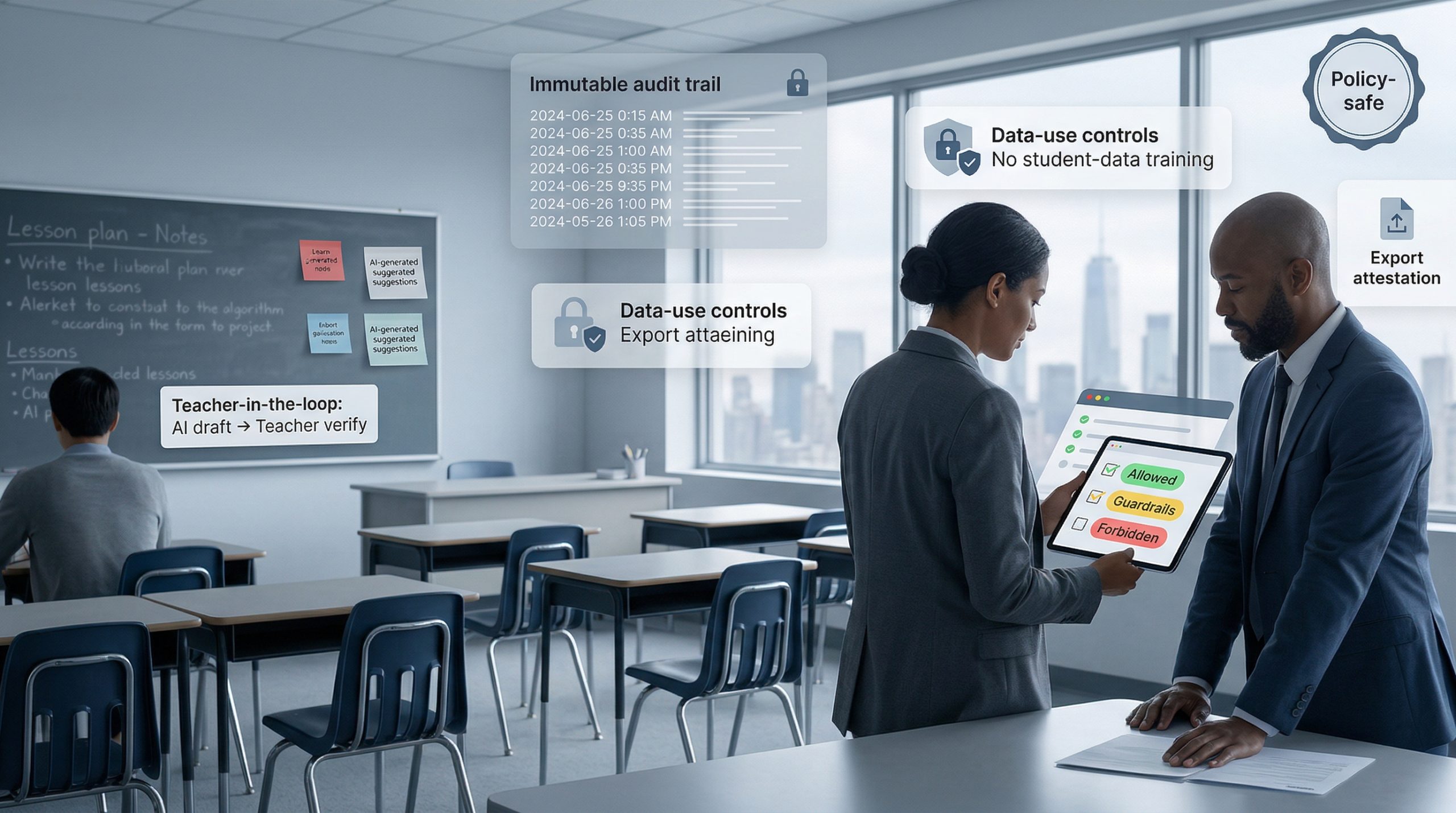
New York City’s preliminary AI guidance for classrooms — explicitly green‑lighting teacher planning and research support while red‑lining any automated decisioning on grades, discipline, special‑education plans and counseling — has produced an actionable procurement signal for the private‑equity and investor (PEI) community: buy or build audit‑first, human‑centred edtech that can be certified as “policy‑safe.” (Gothamist; Chalkbeat; NYTimes)
Policy snapshot
– Red/Yellow/Green rubric: The DOE’s guidance places grading, promotion, discipline, counseling and development of special‑education/504 plans in the red (forbidden) category; lesson and unit planning, translation, brainstorming and drafting of non‑critical communications sit in green (allowed); research support is yellow (allowed with guardrails). (Gothamist; Chalkbeat; NYTimes)
– Data and procurement controls: tools must pass a multi‑step privacy review before adoption; student data cannot be used to train models without explicit approvals; the DOE also signalled plans to expand evaluation capacity, though bias and efficacy testing are not yet required in initial reviews. (NY1; Yahoo)
– Iterative rollout: the DOE opened a public comment window through May 8, underscoring that guidance and procurement timelines will be staged. (NY1)
Why this matters to PEI buyers
NYC’s approach creates procurement arbitrage. By forbidding automated decisioning for any student‑facing determinations while allowing teacher‑facing productivity uses, the policy narrows the set of acceptable vendors to platforms that can demonstrably prevent automated scoring/decisioning, provide auditable logs, and offer contractual and technical controls that satisfy privacy and procurement teams. Districts that mirror NYC’s model will look for “policy‑safe” suppliers — reducing vendor competition for compliant products and strengthening revenue durability for firms that can meet those requirements. (Chalkbeat; GovTech)
For investors, that shift translates into two linked opportunities: (1) acceleration of procurement for vendors that ship compliance artifacts and human‑in‑the‑loop workflows; and (2) consolidation possibilities for roll‑ups that bundle lesson‑planning, assessment services and governance tooling into an audit‑first stack. With LLMs‑in‑education market forecasts pointing to rapid growth, but causal evidence of classroom learning gains still thin, districts will prefer risk‑averse, audit‑first procurements — a tailwind for PE/strategic buyers who can underwrite the governance premium. (GlobeNewswire; Stanford coverage)
Product capabilities that become procurement “must‑haves”
1) Explicit lockout of automated decisioning: Products must offer configuration or architectural guarantees that make it technically infeasible to use the tool to assign grades, alter placement decisions, or generate special‑education plans without human confirmation and signed verification (for example: no automated numeric score outputs; only AI‑generated suggestions routed to teacher verification). (Chalkbeat)
2) Human‑in‑the‑loop workflows and immutable audit trails: Workflows should enforce teacher initiation → AI draft → teacher refinement → immutable audit log, with exportable attestations suitable for procurement review. (RNA simulated entries)
3) Data‑use guarantees and contract clauses: Vendors must contractually prevent reuse of student data for model training, commit to deletion timelines and provide subprocessor lists and audit rights; SOC2/FERPA/COPPA documentation will shorten procurement cycles. (Yahoo; Vanta)
4) Explainability and bias‑testing roadmap: Even if not mandated initially, districts will ask for explainability artefacts and a roadmap for bias and efficacy testing as DOE evaluation capacity grows. (Chalkbeat)
5) Integration and procurement posture: LMS/SIS interoperability, secure hosting and pre‑packaged procurement artefacts (GPO/co‑op contract templates, security questionnaires) will materially accelerate district adoption. (procurement playbook)
Go‑to‑market, channel and M&A playbook for PEI investors
– Fast‑follow acquisition targets: Early‑stage teacher‑facing lesson‑planning SaaS and H‑in‑the‑loop scoring marketplaces that already produce audit logs and provide a “no‑auto‑grade” configuration become prime tuck‑in targets. Simulated RNA profiles—EduPlanAI (teacher‑planning SaaS, Series A, simulated) and AssessGuard (human‑scoring platform, growth‑equity profile, simulated)—illustrate the kind of product and metric mix investors should prioritise. (RNA simulated entries)
– Roll‑up thesis: Combine lesson‑planning, managed scoring services and governance tooling (privacy attestations, explainability dashboards, evidence APIs) to create a recurring‑revenue stack that maps directly to district RFP language and shortens procurement friction. Archive playbooks document how policy inflection points have previously catalysed M&A waves. (PEI archive recommendations)
– Channel strategy: Target district procurement bodies, buying co‑ops (GPOs), city procurement shops and chief academic officers rather than DTC channels. Pre‑populate RFP responses with SOC2/Praivacy addendums and evaluation plans to compress sales cycles. (archive GTM guidance)
– Value creation levers: Standardise compliance docs and certifications, build LMS bundles, offer managed human‑scoring to bridge transition periods, and productise audit and evidence APIs for procurement teams. (Vanta; Kiteworks examples)
Diligence checklist and investment risks
– Technical enforcement: Verify through architecture diagrams and live demos that the product can be locked into a no‑automated‑grading mode and that teacher sign‑off is enforced and captured immutably.
– Data governance: Confirm contractual commitments preventing student data reuse for training, deletion timelines, subprocessors and audit rights; require sample vendor addendums. (Yahoo; Vanta)
– Efficacy evidence: Demand causal pilot designs or randomized trials where available; absent solid evidence of learning gains, ROI claims are fragile. (Stanford review)
– Procurement and contract flow‑downs: Evaluate whether federal/state contract clauses or future GSA/NIST requirements could force reengineering or change economics after acquisition. (GSA coverage)
– Labor and political risk: Model potential teacher/union pushback where automation threatens roles; a clear human‑control positioning reduces adoption risk. (teacher‑union reporting)
Practical next steps for PEI deal teams
1) Screen existing pipelines for targets that (A) can proof a no‑automated‑grading configuration, (B) export immutable audit logs and (C) possess FERPA/COPPA/SOC2 artifacts; prioritise firms with district pilots. (Chalkbeat; NYDailyNews)
2) Prepare a compliance playbook bundle — contract templates, privacy addendums and vendor attestation forms — to shorten bid timelines when RFP windows open. (Vanta checklist)
3) Negotiate pilot partnerships that include causal evaluation metrics or randomized designs to build the efficacy evidence districts will demand, and consider offering shared‑cost pilots to win early proofs. (Stanford evidence context)
4) Build a roll‑up shortlist of tuck‑ins that complement lesson‑planning and assessment platforms and accelerate the path to an evidence‑and‑governance stack. (RNA simulated archetypes; PEI archive)
Concluding synthesis
NYC’s preliminary AI playbook raises the procurement bar for anyone seeking district adoption while simultaneously narrowing competition for compliant, human‑centric products — a clear arbitrage for PE/strategic buyers who can assemble audit‑first lesson‑planning, assessment and governance stacks that map to district risk constraints and procurement workflows. (PIX11; Chalkbeat; RNA simulated entries)
Sources: NYC DOE preliminary guidance and reporting (Gothamist; Chalkbeat; NYTimes; NY1; PIX11), press coverage and market context (GovTech; GlobeNewswire; Stanford review), governance and compliance playbooks (Vanta; Kiteworks), and PEI archive and simulated RNA profiles referenced above.