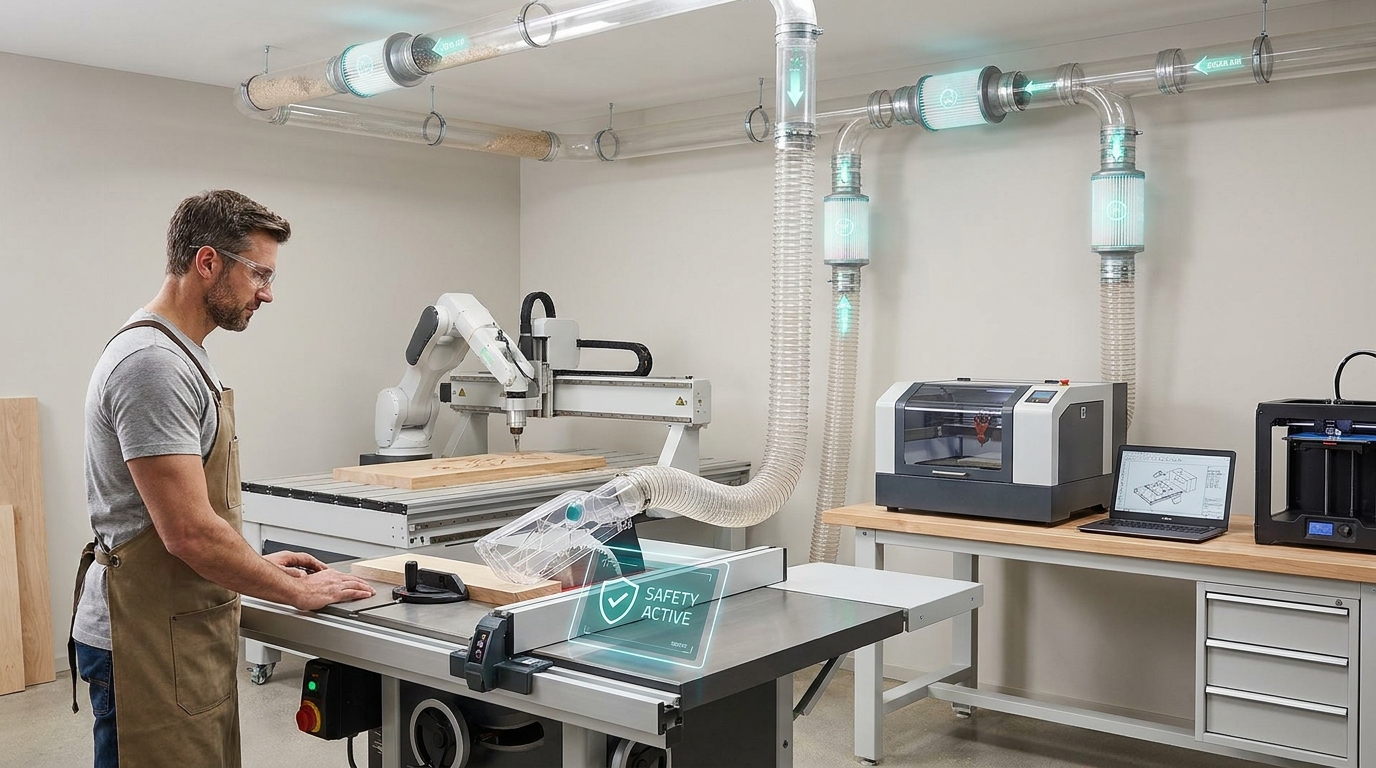
I’ve seen workshops that are nigh on dust-free,” marvels furniture maker and woodwork instructor Ryan Saunders.
It’s one of the big changes that technology has bought to the woodworking business in recent decades.
“We’ve understood so much more about the safety of our lungs,” Saunders says.
From high-pressure extractors to high-quality filters, there are more tools than ever before to protect the lungs of people working with wood.
Better dust collection was at the core of a company launched in 2024 by Chris de Jongh, an engineer and woodworker.
He noticed that companies were running their dust collections systems too much, sometimes around the clock.
So his company, BlastGate.com, sells a device that “ensures that you’re only extracting dust when needed”.
For one Dutch client making kitchens, the system paid for itself within half a year, according to de Jongh.
The latest tech has also been employed to make machine tools, like table saws, safer.
US company SawStop also developed a safety feature that stops a saw before it can cause injuries. The blade has an electrical signal that detects when skin comes into contact with the metal.
Within five milliseconds of that contact, the spinning blade comes to a dramatic brake, and the blade whooshes below the table.
Because the safety system is activated by contact, a finger may get nicked.
But “that is the difference between having a plaster and going to a plastic surgeon,” says Saunders, who also demonstrates SawStop machines.
Since 2022, the Hand Guard technology of the German company Altendorf has used cameras and AI to detect when a hand comes too close to a blade.
Both companies are continuing to collect data to refine when the safety feature gets triggered. False alarms would result in unnecessary downtime, while the machine is reset.
Take a woodworker from the 19th century and put him in a modern workshop and what would he notice?
The principles behind many of the modern tools would be familiar to woodworkers from previous centuries, believes Alex Marsh, director of operations at Pow, a nonprofit workshop in West London.
Pow’s larger machines with digital components, like its laser cutter, would be less recognisable to time travellers.
The same would go for 3D printers, which some woodworkers use to create personalised tools.
Another piece of equipment drawing woodworkers to Pow is its computer numerical control (CNC) router, a large cutting machine controlled by a computer.
While CNC machines have been around for decades, “one tangible advance is that the software has gotten considerably easier to use,” Marsh says. Aspects like automatic tool changing have also eased the work.
Marsh adds that this has “broadened the range of people that can use these machines, as well as the processes you can use them for”.